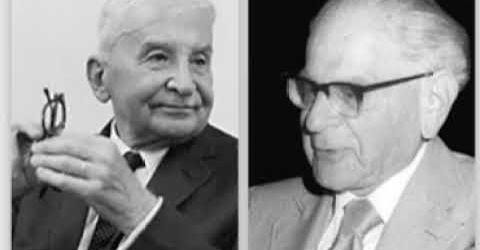
If two schools of thought seem to be not only right, but incompatible, there are only two choices: 1) one or both of them are wrong; or 2) their differences may be resolved through semantic reconciliation and the discarding of mistakes that are of minor consequence. Rafe and I have been on the latter path for some time and hope our work encourages others to take the same path.
Showing posts with label Darwinism. Show all posts
Showing posts with label Darwinism. Show all posts
Tuesday, January 02, 2024
Mises and Popper on Action
Today the Ludwig von Mises Institute published my short article, "Mises and Popper on Action," a result of my joint project with Rafe Champion to explore the synergy between Popper and the Austrians (The Austrian School of Economics as a Popperian Metaphysical Research Programme).


Saturday, December 15, 2018
Are Societal Structures Really "… the result of human action, but not the execution of any human design?"
This phrase from
Adam Ferguson (quote in context here)
is bandied about quite a bit by supporters of markets and, specifically, in the
context of Friedrich Hayek's views of markets and society. The phrase brings to
mind the inductivist view that science proceeds first by
observations–"just observe." However, in the case of creating social
structures, "just act." This formulation can lead one to think that
in science any random observation can lead to knowledge, or in society, any action
will contribute to the spontaneous order. Such thinking denigrates
the individual and minimizes such achievements as Newton's
laws of motion and Mises's work on socialism's calculation problem.
If we accept Mises's
definition of human action, "purposeful behavior" (Human Action, p 11), we take it that each action is rational and aimed at
a certain end (this is not to say that impulsive or instinctual actions
involve thought processes, but that the ones that concern us in economics and
social interaction do). Therefore we can say that each action is designed by
the individual for a specific purpose. When individuals act with a purpose in
mind they are supported by the entire background of biological and societal
evolution that preceded them. For that reason, actions are not random but are
stochasticly targeted in the sense Denis Noble describes in Dance to the Tune of Life (194-197), varying only part of the theoretical structure.
In acting, each person impinges upon the plans of others. As each person adjusts their plans to mesh with others' their actions produce effects that feed back into the system, producing new effects unanticipated by the original actors. These new effects produce plan revisions, and so on. The pattern is the same as Karl Popper's tetradic schema:
In acting, each person impinges upon the plans of others. As each person adjusts their plans to mesh with others' their actions produce effects that feed back into the system, producing new effects unanticipated by the original actors. These new effects produce plan revisions, and so on. The pattern is the same as Karl Popper's tetradic schema:
P1 → TT → EE → P2
Where P1 is the initial problem state, TT is a tentative solution or theory, EE is the error-elimination process applied to the theory, and P2 represents the new problem state that has been generated by the process.
This concise representation is simply that of a Darwinian or evolutionary approach to knowledge, reflecting the iterative process of markets that is so foreign to the state and political governance.
At this moment in
history, it appears that what we are in such a position with economics and
society. In economics we are in the grips of the neoclassical synthesis, which
provides an intellectual argument for the state, an institution that already
resists falsification through power and violence. In society the failed
arguments of natural rights have opened the floodgates to identity politics and the
intellectually sterile ad hoc strategy
of resistance to it. It would seem that we are heading for a giant reset in
which one hopes for a rethinking of the whole project of governance resulting
in institutions developed through the trial-and-error of what I have called evolutionary liberalism.
Only then might we have Peace on Earth.
Monday, June 11, 2018
A Popperian View of The Selfish Gene
 |
| The Selfish Gene (Photo credit: Wikipedia) |
The Problem
Richard Dawkins, in the "Preface to the 1976 edition" of The Selfish Gene wrote:We are survival machines—robot vehicles blindly programmed to preserve the selfish molecules known as genes. This is a truth which still fills me with astonishment. Though I have known it for many years, I never seem to get fully used to it. (1989, v)Although I never finished the book, I read enough of it years ago to understand, and accept, what Dawkins was selling—that these inanimate molecules were selfishly controlling evolution.
I believed this narrative for many years—actually, until recently. Then, having become ever more familiar with Karl Popper's philosophy and his evolutionary epistemology, I came to believe Dawkins's narrative was false for reasons I will attempt to explain.
For those readers who are not familiar with Popper's work, some introductory remarks are in order. For a wider review of Popper's most important works, see Rafe Champion's Popper: The Champion Guides.
The Tetradic Schema
Popper expressed his evolutionary, trial-and-error epistemology in a "tetradic schema":
This schema may be read as Problem situation 1 produces Tentative Solutions that undergo Error Elimination, leading to the new Problem situation 2. The schema represents an infinite process, as each new P2 becomes a new P1. Note that TS may represent an array of possible solutions.
Popper linked his thinking to Darwinian evolution in his early works, writing in The Logic of Scientific Discovery, "We choose the theory which best holds its own in competition with other theories; the one, which by natural selection, proves itself the fittest to survive" (1959, 108). In his "Of Clouds and Clocks," Popper made the connection between his tetradic schema and evolution, writing that it describes "the fundamental evolutionary sequence of events" (1972, 243).
Three Worlds
Popper divided the world into three categories:- World 1: the world of physical objects.
- World 2: the world of mental states.
- World 3: the world of objective—that is, intersubjectively criticizable—knowledge.
Much as Mises discussed action in the context of humans, Popper focused on the human component of these categories, while acknowledging a glimmer of world 3 in the preconscious animals. Examples of the latter would be a spider's web (1972, 112) or a bird's nest (1972, 117). He did assert a connection between animal knowledge and genetic information:
In Denis Noble's book, The Music of Life, he presents two possible alternatives for genes. The Dawkins version is that living things are the slaves of genes, while the other is that genes are the prisoners of organisms. Each of these choices seems somewhat silly (as Denis Noble has informed me, they were meant to be, as alternatives between which there was no way to choose through experiment). After all, are we slaves of our libraries, or are libraries our prisoners? I would suggest that neither is the case, and that we create libraries as world 3 extensions of ourselves with which we interact, enhancing our survival (Popper, 1994).
*I use the word "libraries" to represent those world 3 objects that are represented in world 1 form.
MacAllister, James (2009). "A Commentary on Homage to Darwin Debate." Retrieved June 5, 2018 from NanoPDF: https://nanopdf.com/download/homageto-darwin-debate-commentary_pdf.
Popper, Karl R., (1959). The Logic of Scientific Discovery. Toronto: University of Toronto Press.
Popper, Karl R., (1972). Objective Knowledge. Oxford: at the Clarendon Press.
Popper, Karl R., (1994). Knowledge and the Body-Mind Problem: In defence of interaction. (M. A. Notturno, Ed.), London: Routledge.
This statement of the situation is meant to describe how knowledge really grows. It is not meant metaphorically, though of course it makes use of metaphors. The theory of knowledge which I wish to propose is a largely Darwinian theory of the growth of knowledge. From the amoeba to Einstein, the growth of knowledge is always the same: we try to solve our problems, and to obtain, by a process of elimination, something approaching adequacy in our tentative solutions. (1972, 261)World 3 in a human context contains the consciously-constructed results of conjecture and refutation that Popper called objective knowledge. For the process of refutation or error correction, the conjectures being evaluated must be in a form to be criticized. For that reason, world 3 objects are generally represented in world 1 objects like books or recordings. I believe, in the case of humans, they may also be represented in myths and ballads that are passed on through retelling and memory.
Genetic Dualism
In "Evolution and the Tree of Knowledge" (1972, p 256-284) Popper proposes a conjecture:"The problem to be solved by [my conjecture] is the old problem of orthogenesis versus accidental and independent mutation—Samuel Butler's problem of luck or cunning. It arises from the difficulty of understanding how a complicated organ, such as the eye, can ever result from the purely accidental co-operation of independent mutations.
"Briefly, my solution of the problem consists in the hypothesis that in many if not all of those organisms whose evolution gives rise to our problem—they may include perhaps some very low organisms—we may distinguish more or less sharply [at least] two distinct parts: roughly speaking a behavior-controlling part like the central nervous system of the higher animals, and an executive part like the sense organs and the limbs, together with their sustaining structures." (p 273)
Popper calls this conjecture "genetic dualism" and suggests that it "strongly resembles mind-body dualism."
In the cases which we wish to explain, certain inherited dispositions or propensities like those of self-preservation, seeking food, avoiding dangers, acquiring skills by imitation, and so on, may be regarded as subject to mutations that do not as a rule induce any significant change in any organs of the body, including the sense organs, except those organs (if any) which are the genetic carriers of the dispositions or propensities referred to. (p 273)Popper goes on to explain that changes in the executive part that occur independently of the behavior-controlling part are likely to be unfavorable, while changes in the behavior-controlling part prepare the way for taking advantage of later changes in the executive part. He concludes, now referring to the behavior-controlling part as the "central propensity structure":
Once a new aim or tendency or disposition, or a new skill, or a new way of behaving has evolved in the central propensity structure, this fact will influence the effects of natural selection in such a way that previous unfavourable (though potentially favourable) mutations become actually favourable if they support the newly established tendency. But this means that the evolution of the executive organs will become directed by that tendency or aim, and thus 'goal-directed'. [emphasis in original] (p 278)If we consider the context of all known living organisms, the possibility that world 3 is not simply a human phenomenon, and the conjecture of genetic dualism we find an argument against Dawkins's theory.
Are We Slaves of Libraries*?
Just as humans need books, and by extrapolation, libraries, to pass on knowledge, so too must cells have the capability to encode their knowledge to pass on an organism's characteristics. To do so, cellular processes must have discovered or even created DNA and used it to store genetic information. Perhaps this discovery occurred through random combination, or through some method yet to be understood that might be called "unconscious intelligence." In relation to the latter there are a number of competing hypotheses including vitalism, panpsychism, holism, etc., all of which are speculative and might be called "skyhooks" by the likes of Daniel Dennett. The primary point here is that the acting or behavior-controlling part is cellular processes, while genes fulfill the role of the executive part. Applying Popper's conjecture to cells, genes would be relegated to a passive role in the same relationship to cellular processes and libraries are to humans. The question then becomes, are we slaves of libraries?In Denis Noble's book, The Music of Life, he presents two possible alternatives for genes. The Dawkins version is that living things are the slaves of genes, while the other is that genes are the prisoners of organisms. Each of these choices seems somewhat silly (as Denis Noble has informed me, they were meant to be, as alternatives between which there was no way to choose through experiment). After all, are we slaves of our libraries, or are libraries our prisoners? I would suggest that neither is the case, and that we create libraries as world 3 extensions of ourselves with which we interact, enhancing our survival (Popper, 1994).
Evidence for Genetic Dualism
In the second part of the Homage to Darwin debate held at Oxford (41:36) (also documented in (MacAllister, 2009, p 16)) Noble points out that implanting a genome of one species in the egg cell from another is only able to develop so far before "freezing."There are extremely few cases of cross species cloning that lead to a living organism. What that tells me is that the genetic 'program' --if we can use that metaphor--lies as much in the cell as in the genome.I suspect that this observation is in agreement with Popper's genetic dualism in that the control apparatus, the cellular processes, are not able to process the DNA presented to them.
Conclusion
Whatever Dawkins may have thought he was doing when he wrote The Selfish Gene, he fostered a belief that there was some control of evolution exhibited by genes. But when we apply Popper's thinking to the problem, we come to a completely different conclusion—that cellular processes are the world 2 behavior-controlling part that makes evolution appear goal-directed while the world 1 object, DNA, performs the world 3, "library" function.*I use the word "libraries" to represent those world 3 objects that are represented in world 1 form.
MacAllister, James (2009). "A Commentary on Homage to Darwin Debate." Retrieved June 5, 2018 from NanoPDF: https://nanopdf.com/download/homageto-darwin-debate-commentary_pdf.
Popper, Karl R., (1959). The Logic of Scientific Discovery. Toronto: University of Toronto Press.
Popper, Karl R., (1972). Objective Knowledge. Oxford: at the Clarendon Press.
Popper, Karl R., (1994). Knowledge and the Body-Mind Problem: In defence of interaction. (M. A. Notturno, Ed.), London: Routledge.
Tuesday, February 14, 2017
Contra Hayek, Cultural Evolution IS Darwinian
In Hayek's The Fatal Conceit (1988) there is a section titled "The Mechanism of Cultural Evolution Is Not
Darwinian." Within the section Hayek takes the position that Darwinian theory applies only to biological and not cultural evolution. He writes that "cultural evolution simulates Lamarkism" (25).
However, when we take an abstract view of Darwinism—variation, selection, and retention—we see that Hayek is mistaken. The problem of Lamarkism is not that characteristics are acquired, as characteristics resulting from mutations are also acquired; but that there is no mechanism of retention. Rather than DNA, it is the institutions of society that pass on the mutations of society—the new ideas, technologies, and customs. The mechanism of cultural retention is what Karl Popper called World 3 (1972).
The mention of World 3 prompts the suggestion that DNA is also a World 3 phenomenon created by processes in the cell for purposes of retention. Where this suggestion leads is anybody's guess.
Bibliography
Hayek, F.A., 1988, The Fatal Conceit, Chicago, University of Chicago Press.
Popper, K.R., 1972, "On the Theory of the Objective Mind" in Objective Knowledge, London, Oxford University Press, 153-190.
Darwinian." Within the section Hayek takes the position that Darwinian theory applies only to biological and not cultural evolution. He writes that "cultural evolution simulates Lamarkism" (25).
However, when we take an abstract view of Darwinism—variation, selection, and retention—we see that Hayek is mistaken. The problem of Lamarkism is not that characteristics are acquired, as characteristics resulting from mutations are also acquired; but that there is no mechanism of retention. Rather than DNA, it is the institutions of society that pass on the mutations of society—the new ideas, technologies, and customs. The mechanism of cultural retention is what Karl Popper called World 3 (1972).
The mention of World 3 prompts the suggestion that DNA is also a World 3 phenomenon created by processes in the cell for purposes of retention. Where this suggestion leads is anybody's guess.
Bibliography
Hayek, F.A., 1988, The Fatal Conceit, Chicago, University of Chicago Press.
Popper, K.R., 1972, "On the Theory of the Objective Mind" in Objective Knowledge, London, Oxford University Press, 153-190.
Subscribe to:
Posts (Atom)