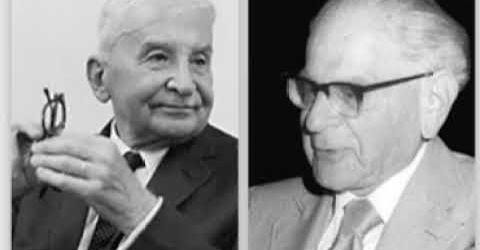
If two schools of thought seem to be not only right, but incompatible, there are only two choices: 1) one or both of them are wrong; or 2) their differences may be resolved through semantic reconciliation and the discarding of mistakes that are of minor consequence. Rafe and I have been on the latter path for some time and hope our work encourages others to take the same path.
Showing posts with label Philosophy of science. Show all posts
Showing posts with label Philosophy of science. Show all posts
Tuesday, January 02, 2024
Mises and Popper on Action
Today the Ludwig von Mises Institute published my short article, "Mises and Popper on Action," a result of my joint project with Rafe Champion to explore the synergy between Popper and the Austrians (The Austrian School of Economics as a Popperian Metaphysical Research Programme).


Monday, October 28, 2013
In Support of Methodological Monism
The appeal of methodological monism – as Popper put it, "the view that all theoretical or generalizing sciences make use of the same method, whether they are natural or social sciences" (1957, 130) – seems undeniable (think Occam's Razor), and it has a number of supporters.1 On the other hand, some in the social sciences – notably members of the Austrian school of economics – suggest methodological dualism or, in the case of Bruce Caldwell (Caldwell, 1982), even methodological pluralism. It appears that these different camps are difficult to reconcile, and to this point no resolution has been found.
When difficulties of this sort arise – where there exist multiple views, all seemingly reasonable, yet
irreconcilable – it is possible that a solution may be found in appealing to a higher level of abstraction. In this case we look to Karl R. Popper's formalization of the scientific method in the following schema (Popper, 1972, 119):
In this discussion our focus is on the error-elimination step. If one thinks of Popper's formulation as "the method", the error-elimination step may be modified as circumstances warrant without altering that method. Popper also referred to this step as "attempted elimination through critical discussion" (1999, 13-4). To acquire new knowledge, we always use this method, substituting the appropriate critical component.2 With this understanding we may actually suggest that Bruce Caldwell is a methodological monist, as he specifically states that his reason for supporting methodological pluralism is that theories require different forms of criticism (Caldwell, 1982, 1-2).
Ludwig von Mises, a strong advocate of methodological dualism (1969, 1-2),3 presents a slightly more difficult case. His dualism differentiated the method in the social sciences from that of the physical sciences by asserting that its axioms were a priori true,4 and that criticisms of the logic used to deduce its theorems were the best method of refuting them. A clarification of Mises's approach (Smith, 1996),
explicity identifying and defending its axioms as synthetic rather than analytic, has tied it more closely to the real world. This clarification has increased the credibility of the approach even though tentative theories, in Popper's view, need no justification. To illustrate Mises's emphasis on criticism we offer the following quote:
When viewed in this more abstract light, Mises's method fits Popper's formulation and does not contradict methodological monism. This fact is comforting as we suspect that the idea that there is only one fundamental method of obtaining knowledge is itself an a priori truth.
In a previous post we suggested that Mises was incorrect in claiming that economics was a subject unconnected with any other science, linking the action axiom with Popper's suggestion that "all life is problem solving" and to the science of biology. Here we have claimed that Mises's method fully complies with the scientific method as formulated by Popper, and that it is only the use of an appropriately different approach to error elimination or criticism that differentiates it from the physical sciences. If we have succeeded in our project it seems clear that economic methodology, as described and practiced by Ludwig von Mises, is scientific, and that the resulting discipline of economics is science.
2 I am grateful to Rafe Champion for bringing this point home.
3 For Mises's discussion of his method see (2003), (1966, 1-142), (1969) and (2006). For discussions by others, see (Boettke, 1998), (Boettke, 2012), (Kirzner, 2001, 69-92), and (Selgin, 1990, 11-18),
4 Mises recognized the observational, i.e. synthetic, component of his axiom (Kirzner, 2001, 88-9).
Boettke, P. J. (1998). Ludwig von Mises. In J. Davis, D. W. Hands, & U. Mäki (Eds.), The Handbook of Economic Methodology (pp. 534-40). Aldershot: Edward Elgar Publishing. Retrieved October 24, 2013, from http://papers.ssrn.com/sol3/papers.cfm?abstract_id=1531088
Boettke, P. J. (2012). Was Mises Right? In P. J. Boettke, Living Economics: Yesterday, today, and tomorrow (pp. 192-212). Oakland, California: The Independent Institute.
Caldwell, B. (1982). Beyond Positivism: Economic Methodology in the Twentieth Century. London: George Allen & Unwin.
Cziko, G. (1995). Without Miracles: Universal Selection Theory and the Second Darwinian Revolution. Cambridge, MA: The MIT Press.
Kirzner, I. M. (2001). Ludwig von Mises. Wilmington, Delaware: ISI Books.
Mises, L. v. (1966). Human Action: A treatise on economics (3rd ed.). Chicago: Henry Regnery.
Mises, L. v. (1969). Theory and History: An interpretation of social and economic evolution. New Rochelle, New York: Arlington House.
Mises, L. v. (2003). Epistemological Problems of Economics (3rd ed.). Auburn, Alabama: Ludwig von Mises Institute.
Mises, L. v. (2006). The Ultimate Foundation of Economic Science: An essay on method (2nd ed.). Indianapolis, Indiana: Liberty Fund.
Popper, K. R. (1957). The Poverty of Historicism. Boston: The Beacon Press.
Popper, K. R. (1972). Epistemology Without a Knowing Subject. In K. R. Popper, Objective Knowledge: An Evolutionary Approach (pp. 106-52). Oxford: Oxford University Press.
Popper, K. R. (1999). The logic and evolution of scientific theory. In K. R. Popper, All Life is Problem Solving (pp. 3-22). London: Routledge.
Selgin, G. A. (1990). Praxeology and Understanding: An analysis of the controversy in Austrian economics. Auburn, Alabama: Ludwig von Mises Institute.
Smith, B. (1996, Spring). In Defense of Extreme (Fallibilistic) Apriorism. Journal of Libertarian Studies, 12(1), 179-192.
Wilson, E. O. (1998). Consilience: The Unity of Knowledge. New York: Alfred A. Knopf.

 |
| English: Karl Popper in 1990. (Photo credit: Wikipedia) |
irreconcilable – it is possible that a solution may be found in appealing to a higher level of abstraction. In this case we look to Karl R. Popper's formalization of the scientific method in the following schema (Popper, 1972, 119):
P1 → TT → EE → P2Where P1 is the initial problem state, TT is a tentative solution or theory, EE is the error-elimination process applied to the theory, and P2 represents the new problem state that has been generated by the process. This concise representation is simply that of a Darwinian or evolutionary approach to knowledge.
In this discussion our focus is on the error-elimination step. If one thinks of Popper's formulation as "the method", the error-elimination step may be modified as circumstances warrant without altering that method. Popper also referred to this step as "attempted elimination through critical discussion" (1999, 13-4). To acquire new knowledge, we always use this method, substituting the appropriate critical component.2 With this understanding we may actually suggest that Bruce Caldwell is a methodological monist, as he specifically states that his reason for supporting methodological pluralism is that theories require different forms of criticism (Caldwell, 1982, 1-2).
 |
| English: Ludwig von Mises in his library (Photo credit: Wikipedia) |
explicity identifying and defending its axioms as synthetic rather than analytic, has tied it more closely to the real world. This clarification has increased the credibility of the approach even though tentative theories, in Popper's view, need no justification. To illustrate Mises's emphasis on criticism we offer the following quote:
Man is not infallible. He searches for truth – that is, for the most adequate comprehension of reality as far as the structure of his mind and reason makes it accessible to him. Man can never become omniscient. He can never be absolutely certain that his inquiries were not misled and that what he considers as certain truth is not error. All that man can do is submit all his theories again and again to the most critical reexamination. This means for the economist to trace back all theorems to their unquestionable and certain ultimate basis, the category of human action, and to test by the most careful scrutiny all assumptions and inferences leading from this bases to the theorem under examination. It cannot be contended that this procedure is a guarantee against error. But it is undoubtedly the most effective method of avoiding error. (Mises, 1966, 68)The critical component in the method is composed of the examination of premises and validation of logic.
When viewed in this more abstract light, Mises's method fits Popper's formulation and does not contradict methodological monism. This fact is comforting as we suspect that the idea that there is only one fundamental method of obtaining knowledge is itself an a priori truth.
In a previous post we suggested that Mises was incorrect in claiming that economics was a subject unconnected with any other science, linking the action axiom with Popper's suggestion that "all life is problem solving" and to the science of biology. Here we have claimed that Mises's method fully complies with the scientific method as formulated by Popper, and that it is only the use of an appropriately different approach to error elimination or criticism that differentiates it from the physical sciences. If we have succeeded in our project it seems clear that economic methodology, as described and practiced by Ludwig von Mises, is scientific, and that the resulting discipline of economics is science.
Footnotes
1 See (Blaug, 1992, 42-47), (Wilson, 1998), and (Cziko, 1995).2 I am grateful to Rafe Champion for bringing this point home.
3 For Mises's discussion of his method see (2003), (1966, 1-142), (1969) and (2006). For discussions by others, see (Boettke, 1998), (Boettke, 2012), (Kirzner, 2001, 69-92), and (Selgin, 1990, 11-18),
4 Mises recognized the observational, i.e. synthetic, component of his axiom (Kirzner, 2001, 88-9).
Bibliography
Blaug, M. (1992). The Methodology of Economics: Or how economists explain (2nd ed.). Cambridge: Cambridge University Press.Boettke, P. J. (1998). Ludwig von Mises. In J. Davis, D. W. Hands, & U. Mäki (Eds.), The Handbook of Economic Methodology (pp. 534-40). Aldershot: Edward Elgar Publishing. Retrieved October 24, 2013, from http://papers.ssrn.com/sol3/papers.cfm?abstract_id=1531088
Boettke, P. J. (2012). Was Mises Right? In P. J. Boettke, Living Economics: Yesterday, today, and tomorrow (pp. 192-212). Oakland, California: The Independent Institute.
Caldwell, B. (1982). Beyond Positivism: Economic Methodology in the Twentieth Century. London: George Allen & Unwin.
Cziko, G. (1995). Without Miracles: Universal Selection Theory and the Second Darwinian Revolution. Cambridge, MA: The MIT Press.
Kirzner, I. M. (2001). Ludwig von Mises. Wilmington, Delaware: ISI Books.
Mises, L. v. (1966). Human Action: A treatise on economics (3rd ed.). Chicago: Henry Regnery.
Mises, L. v. (1969). Theory and History: An interpretation of social and economic evolution. New Rochelle, New York: Arlington House.
Mises, L. v. (2003). Epistemological Problems of Economics (3rd ed.). Auburn, Alabama: Ludwig von Mises Institute.
Mises, L. v. (2006). The Ultimate Foundation of Economic Science: An essay on method (2nd ed.). Indianapolis, Indiana: Liberty Fund.
Popper, K. R. (1957). The Poverty of Historicism. Boston: The Beacon Press.
Popper, K. R. (1972). Epistemology Without a Knowing Subject. In K. R. Popper, Objective Knowledge: An Evolutionary Approach (pp. 106-52). Oxford: Oxford University Press.
Popper, K. R. (1999). The logic and evolution of scientific theory. In K. R. Popper, All Life is Problem Solving (pp. 3-22). London: Routledge.
Selgin, G. A. (1990). Praxeology and Understanding: An analysis of the controversy in Austrian economics. Auburn, Alabama: Ludwig von Mises Institute.
Smith, B. (1996, Spring). In Defense of Extreme (Fallibilistic) Apriorism. Journal of Libertarian Studies, 12(1), 179-192.
Wilson, E. O. (1998). Consilience: The Unity of Knowledge. New York: Alfred A. Knopf.
Monday, April 30, 2012
In Defense of Karl Popper and Piecemeal Social Engineering
 Karl Popper in 1990. (Photo credit: Wikipedia)
Karl R. Popper was one of the most influential philosophers of science in the 20th century. His ideas on inductivism and falsifiability transformed the philosophy of science, creating credibility when he turned his mind to the social sciences. Over the course of his lifetime he moved from a strong commitment to social democracy to support for liberal democracy, possibly due to the influence of his longtime friend, Friedrich Hayek.
In The Open Society and Its Enemies Popper proposed something he called “piecemeal social engineering.”[1] In this regime he suggested that governments implement small societal changes and then critically evaluate the results. He also mentioned that private individuals and businesses were participants in this process saying:
As mentioned earlier, Popper did suggest that businesses could, in effect, also participate in piecemeal social engineering by implementing different business plans and offering revised or different products. He failed to realize that what seemed to him to be a minor component was in fact the most significant and could accomplish his goal of societal evolution more effectively.
The fact is that businesses in the free market have built-in mechanisms that signal difficulties and facilitate learning:
Thus, we can say that Popper’s idea – piecemeal experimentation with the expectation of finding problem solutions – was sensible, but his means – governments of liberal democracies – could not accomplish that end. On the other hand, a society free of government intervention and based on profit and loss has the tools required to accomplish it.
[1] Popper, Karl R., The Open Society and Its Enemies, Volume I: The Spell of Plato, (New York: Harper & Row, 1963), 158.
[2] Ibid, 162.
[3] Magee, Bryan, Philosophy and the Real World: An Introduction to Karl Popper, (La Salle, Illinois: Open Court, 1985), 75.
Karl Popper in 1990. (Photo credit: Wikipedia)Karl R. Popper was one of the most influential philosophers of science in the 20th century. His ideas on inductivism and falsifiability transformed the philosophy of science, creating credibility when he turned his mind to the social sciences. Over the course of his lifetime he moved from a strong commitment to social democracy to support for liberal democracy, possibly due to the influence of his longtime friend, Friedrich Hayek.
In The Open Society and Its Enemies Popper proposed something he called “piecemeal social engineering.”[1] In this regime he suggested that governments implement small societal changes and then critically evaluate the results. He also mentioned that private individuals and businesses were participants in this process saying:
Even a man who opens a new shop, or who reserves a ticket for the theatre, is carrying out a kind of social experiment on a small scale ; and all our knowledge of social conditions is based on experience gained by making experiments of this kind.[2]
In the context that Popper suggested it most free market advocates would find his view of social engineering to be anathema; but if we view it critically and in the context of Popper’s more abstract ideas, specifically “evolutionary epistemology,” we can come to a different and positive conclusion.
Consider Bryan Magee’s representation of Popper’s view of problem solving in society when he says, “Because he regards living as first and foremost a process of problem-solving he wants societies which are conducive to problem-solving.”[3] When Popper suggested that liberal democracies could legislate small changes in the societal structure, evaluate the results and either repeal or retain the changes he was arguing against utopian views and for such a society. As such it was a significant advancement in thinking about societal changes and a sensible argument against all utopian schemes. Unfortunately, Popper was naïve about the ability of governments, even those of liberal democracies, to evaluate the results of their actions and to learn from them.
Governments are unable to learn from their mistakes for a number of reasons:Consider Bryan Magee’s representation of Popper’s view of problem solving in society when he says, “Because he regards living as first and foremost a process of problem-solving he wants societies which are conducive to problem-solving.”[3] When Popper suggested that liberal democracies could legislate small changes in the societal structure, evaluate the results and either repeal or retain the changes he was arguing against utopian views and for such a society. As such it was a significant advancement in thinking about societal changes and a sensible argument against all utopian schemes. Unfortunately, Popper was naïve about the ability of governments, even those of liberal democracies, to evaluate the results of their actions and to learn from them.
- The individuals supporting a specific experiment risk citizens’ resources, not their own.
- In a mixed economy, government does pay market prices for the resources it consumes, but as a monopoly it forces the populace to pay arbitrary prices for the goods and services it provides.
- There is no signal such as profit or loss that can inform the experimenters of their success or failure. In fact, it is widely suggested that government should undertake projects that are “desired” but that generate losses.
As mentioned earlier, Popper did suggest that businesses could, in effect, also participate in piecemeal social engineering by implementing different business plans and offering revised or different products. He failed to realize that what seemed to him to be a minor component was in fact the most significant and could accomplish his goal of societal evolution more effectively.
The fact is that businesses in the free market have built-in mechanisms that signal difficulties and facilitate learning:
- The individuals involved are risking their own or investors’ resources – resources that are freely given and are at risk in the project. This risk factor dampens the enthusiasm for projects that appear fantastic or utopian as opposed to realistic.
- Businesses charge prices that must reflect customers’ values.
- If income minus expenses is negative that signals that the business’s inputs are not creating a value for consumers that justifies the consumption of resources. The individuals involved must make the decision whether to continue to consume capital or abandon the project.
Thus, we can say that Popper’s idea – piecemeal experimentation with the expectation of finding problem solutions – was sensible, but his means – governments of liberal democracies – could not accomplish that end. On the other hand, a society free of government intervention and based on profit and loss has the tools required to accomplish it.
[1] Popper, Karl R., The Open Society and Its Enemies, Volume I: The Spell of Plato, (New York: Harper & Row, 1963), 158.
[2] Ibid, 162.
[3] Magee, Bryan, Philosophy and the Real World: An Introduction to Karl Popper, (La Salle, Illinois: Open Court, 1985), 75.
Wednesday, September 09, 2009
The Observational Evidence for a priori Knowledge
Karl Popper, the philosopher of science, quite clearly supports the concept of a priori knowledge. Not knowledge as in knowing the laws of gravitation, but knowledge as in knowing about and how to deal with gravitation.
In the essay "The Epistemological Position of Evolutionary Epistemolgy" in the essay collection All Life is Problem Solving, Popper suggests that life must know something about the universe in order to survive through even the first few minutes of its existence.
![Reblog this post [with Zemanta]](https://lh3.googleusercontent.com/blogger_img_proxy/AEn0k_sDoOLkj8RMoBfHXUmKqa-Ahdf1J1zK0cSo50RnoAk9RH1aPLtkE2xv-NYNSs94bnEtNdI0vheicUeSDMyNZPReKGv5BV4LY-XnEPn7Nk51DDJkPOwxwnWrrC4xZZGuVkzzSxnnFHHVYhMsCR_tTiTC=s0-d)
Karl Popper, the philosopher of science, quite clearly supports the concept of a priori knowledge. Not knowledge as in knowing the laws of gravitation, but knowledge as in knowing about and how to deal with gravitation.
In the essay "The Epistemological Position of Evolutionary Epistemolgy" in the essay collection All Life is Problem Solving, Popper suggests that life must know something about the universe in order to survive through even the first few minutes of its existence.
For the adaptation of life to its environment is a kind of knowledge. Without this minimal knowledge, life cannot survive.The observable fact that life exists tells us that this knowledge, which Popper calls "genetically a priori," also exists.
Subscribe to:
Posts (Atom)