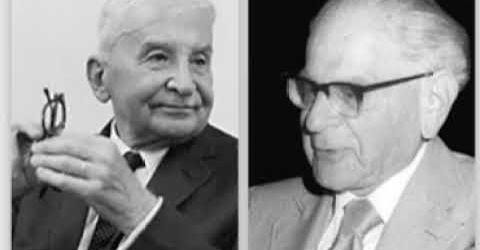
If two schools of thought seem to be not only right, but incompatible, there are only two choices: 1) one or both of them are wrong; or 2) their differences may be resolved through semantic reconciliation and the discarding of mistakes that are of minor consequence. Rafe and I have been on the latter path for some time and hope our work encourages others to take the same path.
Showing posts with label Philosophy. Show all posts
Showing posts with label Philosophy. Show all posts
Tuesday, January 02, 2024
Mises and Popper on Action
Today the Ludwig von Mises Institute published my short article, "Mises and Popper on Action," a result of my joint project with Rafe Champion to explore the synergy between Popper and the Austrians (The Austrian School of Economics as a Popperian Metaphysical Research Programme).
Tuesday, February 04, 2014
Karl Popper's Three Worlds and "The Market"
Introduction
Talking about "the market" in a more generalized way – that is, one which includes all of the living world and nonconsensual interactions that occur between humans and between species – requires increased semantic clarity. In order to achieve this increased clarity Karl Popper's three worlds can be used as a model. After introducing a terminology that parallels that of Popper its potential utility is discussed.
Three Worlds, Three Markets
 |
| English: Karl Popper in 1990. (Photo credit: Wikipedia) |
Firstly, there is the market that is composed of the physical world. As Popper says, in describing world 1:
There is, first, the world that consists of physical bodies: of stones and of stars; of plants and of animals; but also of radiation, and of other forms of physical energy. I will call this physical world ‘world 1’. (1978, 143)This market consists of all of the interactions, physical and/or chemical, that occur in the physical world. These interactions, as far as we know, are not guided by conjectural knowledge. This physical market is called "market 1".
Market 1 can be subdivided into the living and non-living, as Popper suggests:
If we so wish, we can subdivide the physical world 1 into the world of non-living physical objects and into the world of living things, of biological objects; though the distinction is not sharp. (1978, 143)Secondly, there is the market of conjectural knowledge. This description might be thought to augment Popper's world 2, which he described as follows:
There is, secondly, the mental or psychological world, the world of our feelings of pain and of pleasure, of our thoughts, of our decisions, of our perceptions and our observations; in other words, the world of mental or psychological states or processes, or of subjective experiences. I will call it ‘world 2’. (1978, 143)Popper's view is expanded to include the conjectural knowledge encoded in DNA or any similar, yet-to-be-discovered encoding system. This market is called "market 2".
Again, market 2 can be subdivided following Popper's prescription:
World 2 could be subdivided in various ways. We can distinguish, if we wish, fully conscious experiences from dreams, or from subconscious experiences. Or we can distinguish human consciousness from animal consciousness. (1978, 143)Thirdly, there is the market of expressed knowledge. This market consists of the actions taken based on the conjectural knowledge of market 2. Popper describes world 3 as follows:
By world 3 I mean the world of the products of the human mind, such as languages; tales and stories and religious myths; scientific conjectures or theories, and mathematical constructions; songs and symphonies; paintings and sculptures. But also aeroplanes and airports and other feats of engineering. (1978, 144)In striking contrast to his descriptions of worlds 1 and 2, Popper includes only "the products of the human mind" (emphasis added). Omitting the non-human expressed knowledge of plants and animals, including everything from the behavior of the E. coli bacterium (Cziko, 1995, 120) to the engineering feats of the Great Sequoias and honey bees, clearly damages the consistency of the discussion if nothing else. As Popper might agree, these expressions of world 2 cannot be criticized without becoming objects in world 3, where criticism is based on evolutionary fit. Notably, this form of criticism also affects world 2 as Popper framed it, culling those living systems whose conjectural knowledge is not up to the task.
With the addition of these non-human components this market is called "market 3". Clearly, the human component of market 3 is where business plans are exposed to the criticisms of consumers, with the result that the objects that appear in market 1 will be created and the conjectural knowledge of market 2 will be modified.
Popper suggests some subdivisions to world 3:
It would be easy to distinguish a number of different worlds within what I call world 3. We could distinguish the world of science from the world of fiction; and the world of music and the world of art from the world of engineering. (1978, 144)Market 3 contains some additional markets – the markets of successful and unsuccessful expressed knowledge, and the markets of voluntarily and involuntarily expressed knowledge. These distinctions are blurred and the two sets definitely overlap.
Conclusion
Where does the forgoing discussion get us? Most importantly, it enables us to talk about society in a non-religious way that unifies it with the rest of the living world. With it we become aware of a wider range of questions that are rarely even asked. Why is killing animals or plants acceptable while killing humans is not? Why is the killing of some humans supported or even demanded? Why is the enslaving of animals widely practiced while enslaving humans is considered barbarous? Would a super-human species treat us more like we treat animals or more like we treat each other?Without an ability to explore these questions in a value-free manner we cannot identify man's position in the universe and investigate what environment is most conducive to his flourishing. Hopefully, we will also be able to discern the difference between conjectural knowledge that is universally applicable and that which is dependent on time and place.
Bibliography
Cziko, G. (1995). Without Miracles: Universal Selection Theory and the Second Darwinian Revolution. Cambridge, MA: The MIT Press.Popper, K. R. (1978), "Three Worlds", In The Tanner Lecture on Human Values (Delivered at The University of Michigan on April 7, 1978). (pp. 143-167). Retrieved November 26, 2013 from http://www.tannerlectures.utah.edu/lectures/documents/popper80.pdf.

Monday, April 30, 2012
In Defense of Karl Popper and Piecemeal Social Engineering
 Karl Popper in 1990. (Photo credit: Wikipedia)
Karl R. Popper was one of the most influential philosophers of science in the 20th century. His ideas on inductivism and falsifiability transformed the philosophy of science, creating credibility when he turned his mind to the social sciences. Over the course of his lifetime he moved from a strong commitment to social democracy to support for liberal democracy, possibly due to the influence of his longtime friend, Friedrich Hayek.
In The Open Society and Its Enemies Popper proposed something he called “piecemeal social engineering.”[1] In this regime he suggested that governments implement small societal changes and then critically evaluate the results. He also mentioned that private individuals and businesses were participants in this process saying:
As mentioned earlier, Popper did suggest that businesses could, in effect, also participate in piecemeal social engineering by implementing different business plans and offering revised or different products. He failed to realize that what seemed to him to be a minor component was in fact the most significant and could accomplish his goal of societal evolution more effectively.
The fact is that businesses in the free market have built-in mechanisms that signal difficulties and facilitate learning:
Thus, we can say that Popper’s idea – piecemeal experimentation with the expectation of finding problem solutions – was sensible, but his means – governments of liberal democracies – could not accomplish that end. On the other hand, a society free of government intervention and based on profit and loss has the tools required to accomplish it.
[1] Popper, Karl R., The Open Society and Its Enemies, Volume I: The Spell of Plato, (New York: Harper & Row, 1963), 158.
[2] Ibid, 162.
[3] Magee, Bryan, Philosophy and the Real World: An Introduction to Karl Popper, (La Salle, Illinois: Open Court, 1985), 75.
Karl Popper in 1990. (Photo credit: Wikipedia)Karl R. Popper was one of the most influential philosophers of science in the 20th century. His ideas on inductivism and falsifiability transformed the philosophy of science, creating credibility when he turned his mind to the social sciences. Over the course of his lifetime he moved from a strong commitment to social democracy to support for liberal democracy, possibly due to the influence of his longtime friend, Friedrich Hayek.
In The Open Society and Its Enemies Popper proposed something he called “piecemeal social engineering.”[1] In this regime he suggested that governments implement small societal changes and then critically evaluate the results. He also mentioned that private individuals and businesses were participants in this process saying:
Even a man who opens a new shop, or who reserves a ticket for the theatre, is carrying out a kind of social experiment on a small scale ; and all our knowledge of social conditions is based on experience gained by making experiments of this kind.[2]
In the context that Popper suggested it most free market advocates would find his view of social engineering to be anathema; but if we view it critically and in the context of Popper’s more abstract ideas, specifically “evolutionary epistemology,” we can come to a different and positive conclusion.
Consider Bryan Magee’s representation of Popper’s view of problem solving in society when he says, “Because he regards living as first and foremost a process of problem-solving he wants societies which are conducive to problem-solving.”[3] When Popper suggested that liberal democracies could legislate small changes in the societal structure, evaluate the results and either repeal or retain the changes he was arguing against utopian views and for such a society. As such it was a significant advancement in thinking about societal changes and a sensible argument against all utopian schemes. Unfortunately, Popper was naïve about the ability of governments, even those of liberal democracies, to evaluate the results of their actions and to learn from them.
Governments are unable to learn from their mistakes for a number of reasons:Consider Bryan Magee’s representation of Popper’s view of problem solving in society when he says, “Because he regards living as first and foremost a process of problem-solving he wants societies which are conducive to problem-solving.”[3] When Popper suggested that liberal democracies could legislate small changes in the societal structure, evaluate the results and either repeal or retain the changes he was arguing against utopian views and for such a society. As such it was a significant advancement in thinking about societal changes and a sensible argument against all utopian schemes. Unfortunately, Popper was naïve about the ability of governments, even those of liberal democracies, to evaluate the results of their actions and to learn from them.
- The individuals supporting a specific experiment risk citizens’ resources, not their own.
- In a mixed economy, government does pay market prices for the resources it consumes, but as a monopoly it forces the populace to pay arbitrary prices for the goods and services it provides.
- There is no signal such as profit or loss that can inform the experimenters of their success or failure. In fact, it is widely suggested that government should undertake projects that are “desired” but that generate losses.
As mentioned earlier, Popper did suggest that businesses could, in effect, also participate in piecemeal social engineering by implementing different business plans and offering revised or different products. He failed to realize that what seemed to him to be a minor component was in fact the most significant and could accomplish his goal of societal evolution more effectively.
The fact is that businesses in the free market have built-in mechanisms that signal difficulties and facilitate learning:
- The individuals involved are risking their own or investors’ resources – resources that are freely given and are at risk in the project. This risk factor dampens the enthusiasm for projects that appear fantastic or utopian as opposed to realistic.
- Businesses charge prices that must reflect customers’ values.
- If income minus expenses is negative that signals that the business’s inputs are not creating a value for consumers that justifies the consumption of resources. The individuals involved must make the decision whether to continue to consume capital or abandon the project.
Thus, we can say that Popper’s idea – piecemeal experimentation with the expectation of finding problem solutions – was sensible, but his means – governments of liberal democracies – could not accomplish that end. On the other hand, a society free of government intervention and based on profit and loss has the tools required to accomplish it.
[1] Popper, Karl R., The Open Society and Its Enemies, Volume I: The Spell of Plato, (New York: Harper & Row, 1963), 158.
[2] Ibid, 162.
[3] Magee, Bryan, Philosophy and the Real World: An Introduction to Karl Popper, (La Salle, Illinois: Open Court, 1985), 75.
Wednesday, May 19, 2010
Article in Liberty Magazine
Liberty has published the issue online that contains an article I wrote called "Laissez Faire Justice" on the cover and "Marketing Morality" in the table of contents. It is an expanded and edited (by Liberty editors) version of my previous post "Competition as a Discovery Procedure for Ethics."
Liberty has published the issue online that contains an article I wrote called "Laissez Faire Justice" on the cover and "Marketing Morality" in the table of contents. It is an expanded and edited (by Liberty editors) version of my previous post "Competition as a Discovery Procedure for Ethics."
2021/10/15 Edit: Replace heading link and dead article link to reflect live URLs.


Tuesday, October 27, 2009
Liberal Fascism
![Reblog this post [with Zemanta]](https://lh3.googleusercontent.com/blogger_img_proxy/AEn0k_tUU4ruuQmp8TSHiwsEEok2UVxkso0TGoFPqydTgk_KTPGYpVO9KGPpgRLeT-Et44uGJ82UAIuthahMWjRCJKMW8_uEpIARnAHWM91HtSY82YVRUDdM-VUcLJH22AFB8iMkblvKfTbWiVrZxROnLd34=s0-d)
I have just finished the book, Liberal Fascism by Jonah Goldberg. The book is quite informative, although not as well-written as I would like and somewhat weakened by the religious orientation that leaks through in a number of places.
Modern liberalism (not the extension of classical liberalism that I support) is clearly linked with the the ideology of fascism of the 20th century. Unfortunately, the author does not identify the neo-cons as heirs to this same ideology, as he himself is a contributor to "National Review" and a supporter their interventionist policy. However, the extensive research as reflected in the end notes is valuable to anyone who suspects that modern liberalism is not quite the compassionate philosophy projected on the Huffington Post.
Saturday, July 04, 2009
Competition as a Discovery Procedure for Ethics
Friedrich Hayek wrote essays concerned with competition in a theoretical sense, e.g. "Competition as a Discovery Procedure," and in a pragmatic sense, e.g. "Denationalisation of Money." The first essay argues (among other things) that competition leads to discoveries of new knowledge that could not have been aimed at. The latter essay was written as a challenge to the monopolization of the monetary system and the resulting failure to create sound money by proposing the introduction of competitive currencies. It is time to challenge another monopoly of the state – that of the ethical or legal system – and suggest that competing ethical systems are the method by which we may approach an ever more sound system.
Ethical systems are generally presented as being handed down from God or derived in some way from human nature. Ayn Rand and Murray Rothbard developed systems explicitly in the latter class. Andrew
J. Galambos claimed to derive an ethical system from science, a claim that may also be lumped in with theirs, being derived from the nature of volitional beings. These claims are not intended by the claimants to be subject to test, but are presented as systems to which people must adhere, even though the systems may be based upon free market, stateless societies (Rothbard's and Galambos's systems are members of this class while Ayn Rand retains the existence of the state).
Ethical systems, where they intersect with the state, produce legal systems that are imposed upon the inhabitants within the borders of a political entity. In the time of monarchy the legal system reflected the religion of the monarch and whatever concepts of justice the monarch held. In modern democracies the legal system is a reflection of the struggle between various groups and may reflect most fundamentally the views of the religious majority. The one system that attempts to reflect evolutionary market forces is English Common Law, but even in that case the discovery process is hampered by the fact that competition between courts is limited and petitioners may not choose the legal system by which a case will be tried. A free market in judicial services would harness the engine of competition in the quest for ethical systems that are more sound and responsive to the consumers' needs.
If individuals may enter into contracts with different companies providing judicial services reflecting different ethical systems (e.g. Christian, Rothbardian, Galambosian, Islamic, etc.) to resolve their disputes, defend or recover their property, etc., one can imagine that there would be a number of problems. But would these problems be greater than the problems that exist between countries
or, in the United States, between local state jurisdictions? Certainly the execution of a judgment or transfer of an alleged criminal between jurisdictions involves some process that would evolve between justice companies. If companies do not have reciprocal agreements, due to remoteness, neglect or aversion, it is possible that disputes that cross their boundaries will not be resolved, and a loss that might be covered by insurance will be incurred.
Each company may codify its ethical system and reference it in its advertising, along with endorsements from its satisfied customers. If a company has an attractive ethical system it can be expected to attract repeat customers and grow. Superior systems will be reproduced and inferior ones will die out. Better ways of handling cases will be sought, successes added and failures dropped, advancing the system using the same method as science.
In Karl Popper's parlance, each ethical system is a theory and is subject to falsification. The falsification method is its profitability. However, it must be remembered that a falsification of an ethical system, as it is a volitional creation, is subject to its circumstances. Certainly, an ethical system that many might find reasonable today would have found few customers in the depths of the Dark Ages. People's beliefs are essential in the discussion of human action, and change over time. So, it is clear that an ethical system introduced into the market "before its time" may fail, only to be rediscovered and retried successfully later.
If the state were to end its monopolization of the justice market, various ethical systems could flourish, some succeeding (generating profits) and some failing (generating losses). Through this system of competition, inferior systems could be weeded out and superior systems discovered.
Sources
F.A. Hayek, Competition as a Discovery Procedure in The Essence of Hayek (Stanford, California: Hoover Institution Press, 1984) 254-265.
F.A. Hayek, Denationalisation of Money: The Argument Refined (London: The Institute of Economic Affairs, 1978).
Bryan Magee, Philosophy and the Real World: An Introduction to Karl Popper (La Salle, Illinois: Open Court, 1985).
![Reblog this post [with Zemanta]](https://lh3.googleusercontent.com/blogger_img_proxy/AEn0k_sm_Qf9esyZ9CMSiJp0k4VZYJb8JbpAR9oxSTLoZNS0f2fLt3PxAILrFzdiHWByzjDUsAi_6dK-jxhv5yXQ0KH5Yb5No5PZko9EriGy-NQFP-pB-y5C389oMtS8zq5_HDbXXxaisgpDuCt8z8HNF0S9=s0-d)
Friedrich Hayek wrote essays concerned with competition in a theoretical sense, e.g. "Competition as a Discovery Procedure," and in a pragmatic sense, e.g. "Denationalisation of Money." The first essay argues (among other things) that competition leads to discoveries of new knowledge that could not have been aimed at. The latter essay was written as a challenge to the monopolization of the monetary system and the resulting failure to create sound money by proposing the introduction of competitive currencies. It is time to challenge another monopoly of the state – that of the ethical or legal system – and suggest that competing ethical systems are the method by which we may approach an ever more sound system.
Ethical systems are generally presented as being handed down from God or derived in some way from human nature. Ayn Rand and Murray Rothbard developed systems explicitly in the latter class. Andrew
J. Galambos claimed to derive an ethical system from science, a claim that may also be lumped in with theirs, being derived from the nature of volitional beings. These claims are not intended by the claimants to be subject to test, but are presented as systems to which people must adhere, even though the systems may be based upon free market, stateless societies (Rothbard's and Galambos's systems are members of this class while Ayn Rand retains the existence of the state).
Ethical systems, where they intersect with the state, produce legal systems that are imposed upon the inhabitants within the borders of a political entity. In the time of monarchy the legal system reflected the religion of the monarch and whatever concepts of justice the monarch held. In modern democracies the legal system is a reflection of the struggle between various groups and may reflect most fundamentally the views of the religious majority. The one system that attempts to reflect evolutionary market forces is English Common Law, but even in that case the discovery process is hampered by the fact that competition between courts is limited and petitioners may not choose the legal system by which a case will be tried. A free market in judicial services would harness the engine of competition in the quest for ethical systems that are more sound and responsive to the consumers' needs.
If individuals may enter into contracts with different companies providing judicial services reflecting different ethical systems (e.g. Christian, Rothbardian, Galambosian, Islamic, etc.) to resolve their disputes, defend or recover their property, etc., one can imagine that there would be a number of problems. But would these problems be greater than the problems that exist between countries
or, in the United States, between local state jurisdictions? Certainly the execution of a judgment or transfer of an alleged criminal between jurisdictions involves some process that would evolve between justice companies. If companies do not have reciprocal agreements, due to remoteness, neglect or aversion, it is possible that disputes that cross their boundaries will not be resolved, and a loss that might be covered by insurance will be incurred.
Each company may codify its ethical system and reference it in its advertising, along with endorsements from its satisfied customers. If a company has an attractive ethical system it can be expected to attract repeat customers and grow. Superior systems will be reproduced and inferior ones will die out. Better ways of handling cases will be sought, successes added and failures dropped, advancing the system using the same method as science.
In Karl Popper's parlance, each ethical system is a theory and is subject to falsification. The falsification method is its profitability. However, it must be remembered that a falsification of an ethical system, as it is a volitional creation, is subject to its circumstances. Certainly, an ethical system that many might find reasonable today would have found few customers in the depths of the Dark Ages. People's beliefs are essential in the discussion of human action, and change over time. So, it is clear that an ethical system introduced into the market "before its time" may fail, only to be rediscovered and retried successfully later.
If the state were to end its monopolization of the justice market, various ethical systems could flourish, some succeeding (generating profits) and some failing (generating losses). Through this system of competition, inferior systems could be weeded out and superior systems discovered.
Sources
F.A. Hayek, Competition as a Discovery Procedure in The Essence of Hayek (Stanford, California: Hoover Institution Press, 1984) 254-265.
F.A. Hayek, Denationalisation of Money: The Argument Refined (London: The Institute of Economic Affairs, 1978).
Bryan Magee, Philosophy and the Real World: An Introduction to Karl Popper (La Salle, Illinois: Open Court, 1985).
Subscribe to:
Posts (Atom)